Federal Reserve Holds Rates Steady
Holding its benchmark interest rate steady, the Federal Reserve said this afternoon that the American economy was likely to expand “at a moderate pace” in coming months.
J.P. Morgan Asset & Wealth Management. “The housing slowdown is proceeding, but it’s not spiraling downward, and the rest of the economy is doing O.K.”
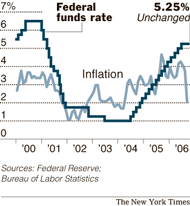
The Fed’s benchmark short-term rate, which influences a wide variety of interest rates, remained at 5.25 percent for the third consecutive meeting. The Fed had raised the federal funds rate on overnight back loans at every meeting from the middle of 2004 through this summer to slow the economy and keep inflation in check.
With the housing market in the midst of a “substantial correction,” as the Fed’s chairman, Ben S. Bernanke, has said, economic growth has slowed this year. The National Association of Realtors reported today that 1.9 percent fewer previously owned were sold in September than in August, a larger drop than forecasters has expected. The median sale price also fell, to $220,000, from $225,000 a year earlier.
But a sharp drop in oil prices — with gasoline falling this week to $2.20 a gallon on average, from more than $3 in early August — appears to have reduced the chances that the slowdown could turn into something more severe, economists say. A Labor Department report earlier this month also showed this summer’s job market to be healthier than had been earlier believed.
If the economy remains fairly strong, the Fed will then have more flexibility to raise its benchmark rate later this year in the event that inflation does not decline on its own, as many Fed officials believe it will.
“Readings on core inflation have been elevated,” the Fed statement said, and could remain so because many companies are operating close to full capacity. “However, inflation pressures seem likely to moderate over time,” it added, thanks to falling oil prices, previous interest-rate increases and the fact that consumers do not expect retail prices to rise rapidly.
There were only two substantive changes to the statement: a new sentence on the economic outlook, forecasting “moderate growth,” and the removal of energy and commodity prices as two of the factors driving up inflation.
“The use of the term ‘moderate,’ I think, was intentionally vague,” David Greenlaw, an economist at Morgan Stanley, said. “They wanted to indicate a degree of confidence that growth would not slow too much, but not express an opinion about whether it would resume an above-trend course” that would cause inflation to accelerate.
Although the drop in gasoline prices has brought down overall inflation, the Fed’s preferred measure of inflation — which excludes energy and food and is less volatile as a result — has risen to an annual rate of 2.5 percent, according to the latest Commerce Department numbers. Mr. Bernanke has said that he would like the core inflation rate to be 1 to 2 percent.
During the two-day meeting that ended today, Fed officials discussed how they might talk publicly in more detail about their policy and forecasts. The meeting, which had been originally scheduled for one day, was expanded to two days earlier this year to leave time for the discussion, which formally began in August.
“They’re not yet ready to unveil formal changes,” Mr. Greenlaw said.
Based on prices of futures contracts tied to Fed policy, traders believe that the Fed will keep its benchmark rate at 5.25 percent into early next year before cutting it next summer. After today’s meeting, the futures prices changed to suggest that traders think a rate increase over the next year had become even less likely.
Bond prices rose after the Fed’s announcement at 2:15 p.m. today. The Treasury’s 10-year note rose nearly half a point in price, pushing its yield, which moves in the opposite direction, down to 4.76 percent this afternoon, from 4.82 percent late Tuesday. Stock prices showed little change, however.
Still, a rate change in the next six months — one way or the other — remains quite plausible, economists say. In speeches and Congressional testimony, Mr. Bernanke has emphasized that the Fed is willing to change its planned policy based on new data.
Jeremy W. Peters contributed reporting.
Source: www.1stwebnews.com
The most popular sites:
News of the world online
Sport betting information
Sex cares and health
Latest celebrity news
Hollywood news online
Today entertainment news
Country health news
50 Cent mp3