Square Feet: Cultivating Server Farms
SEATTLE — Over the last six years, Internap Network Services has survived hundreds of layoffs, a tumbling share price and a delisting threat from Nasdaq. Until this year, it had never been profitable. Still, it was fortunate to be in a business, renting data center space, in which many of its competitors had gone under.
Skip to next paragraph 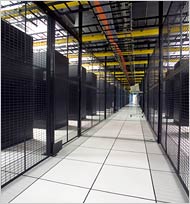
Peter Yates for The New York Times
It has been in business 10 years, and its revenue is expected to increase 12 to 15 percent this year.
Manhattan, Boston and Toronto. All told, the expansion should increase space in Internap-owned data centers, now at 84,051 square feet, by about 14 percent. Revenue is expected to jump 12 to 15 percent this year.
“There are more customers than space available,” said James DeBlasio, chief executive of Internap, which handles data for companies like Delta Air Lines and Bristol-Myers Squibb. “Sometimes their equipment is waiting on the loading dock when the electrician is finishing up.”
The good times are back for data center operators. Over the next 10 years, more than half of all data center operators expect to expand, according to a 2006 survey by Afcom, an association of data center managers in Orange, Calif.
“It’s blown up again and it’s a whole new world,” said Jill Eckhaus, president of Afcom.
Any company that wants to do business online — like the tech giants Microsoft and Google, insurance companies or banks — is racing to construct or expand server farms across the country, or use a company like Internap to provide server space. Data centers vary in size from about 30,000 square feet to more than 300,000 square feet. Development costs generally range from $400 to $1,000 a square foot, depending on whether a center has, for example, raised or concrete floors.
During the tech boom, owners put up as many data centers as they could to satisfy their high-tech customers. Then when many technology companies failed five years ago, a number of operators were pushed into bankruptcy or forced to sell their properties. Suddenly, there was a glut of centers, some built and never used. One million square feet or more of space was empty at that time, said Margie Backaus, chief business officer at Equinix, a data center company.
“It’s like the hotel industry, where no one showed up and they went under,” said Rick Magnuson, co-founder and executive chairman at Digital Realty Trust, a San Francisco real estate investment trust.
But in the aftermath of Hurricane Katrina and the Sept. 11 terrorist attacks, companies are storing their data in multiple locations to keep it safe. Recent federal regulations have also forced health providers, financial institutions and publicly traded companies to maintain more detailed and secure records, further expanding the need for data storage space.
Companies burned by the bust are now more cautious. Rather than putting up new centers, some companies have been buying and renovating old ones, which can be easily updated with new power and cooling equipment. They have also started hunting for office buildings and warehouses that do not require heavy investment to renovate.
For instance, Digital Realty Trust, which focuses exclusively on technology space, more than doubled its holdings, to 54 properties, or a little over 10 million square feet, in the last two years. The trust was founded five years ago and initially bought properties with an eye toward housing backup data for Fortune 1000 companies. As the Internet expanded, Digital Realty reoriented its business to focus on renting space in data centers and Internet hubs.
Its strategy seems to be working. In 2005, its first year as a publicly traded company, Digital Realty was the best-performing real estate investment trust in the country, giving shareholders a 78 percent return, according to the National Association of Real Estate Investment Trusts in Washington. Now, the company is looking for one- and two-story office buildings that can be turned into Internet hubs or server farms.
Companies still in the industry have insulated themselves from the risks because they chose not to own or service the servers or other costly equipment. Instead, they rent space to businesses that act as hosts to servers or Internet network providers. They have further protected themselves by looking beyond the technology sector and soliciting retailers, banks, airlines, health care providers and universities. Internap, for example, also has Toyota and J. P. Morgan Chase as clients.
Source: www.1stwebnews.com
The most popular sites:
News of the world online
Sport betting information
Sex cares and health
Latest celebrity news
Hollywood news online
Today entertainment news
Country health news
50 Cent mp3
