To Lower Costs, Hospitals Try Free Basic Care for Uninsured
AUSTIN, Tex. — Unable to afford health insurance, Dee Dee Dodd had for years been mixing occasional doctor visits with clumsy efforts to self-manage her insulin-dependent diabetes, getting sicker all the while.
Skip to next paragraph 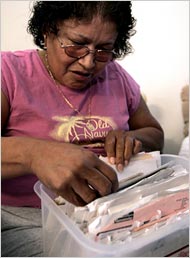
Erich Schlegel for The New York Times
Natavidad Martinez, who has liver cancer, was awarded disability payments but lost her Medicaid coverage.

Erich Schlegel for The New York Times
With preventive efforts, the cost of care for Dee Dee Dodd, a diabetic, was cut nearly in half in 18 months.
hypertension, congestive heart failure or asthma, is a recent tactic of “a handful of visionary hospital systems around the country,” said Karen Davis, president of the Commonwealth Fund, a foundation in New York that concentrates on health care. These institutions are searching for ways to fend off disease and large debts by bringing uninsured visitors into continuing basic care.
The public hospital systems in New York and Denver, for example, have both worked to steer uninsured patients to community clinics, charging modest fees, if any. New York’s public system, the Health and Hospitals Corporation, has assigned some 240,000 uninsured patients to personal primary care doctors. A computerized system tracks those with chronic conditions, and when necessary, social workers contact patients to make sure they get checkups and follow medical advice.
“For most preventive efforts there is an upfront expense,” said Alan D. Aviles, president of the corporation. “But over the long term it saves money.”
Denver’s public system, Denver Health, has 41,000 uninsured patients enrolled in its clinics. Officials there calculate that for every dollar they spend on prenatal care for uninsured women, they save more than $7 in newborn and child care.
The “safety net” plan of the Seton system in Central Texas accepts people making 150 percent to 250 percent of the federal poverty limit and has resources to support 5,000 patients. (People below the poverty line, which is $13,200 a year for a family of two in the contiguous states, can obtain care through the public clinic system.)
Officials scrutinize the records of plan members to see who is still overusing the emergency room or being repeatedly hospitalized — these high-cost patients total some 40 each month — then assign them caseworkers to help improve care and bring down costs.
A special effort to educate 631 asthma patients saved the plan $475,000 in one year, Seton officials said.
In a more unusual step, Seton officials also look for frequent emergency room users who do not qualify for the hospital’s charity plan because they live in a different county, like Ms. Dodd, or have incomes just above the threshold. In a dozen cases so far, all involving diabetics, a committee has judged that it makes financial sense to bring these people into the charity plan anyway and provide intensive support.
Other answers to the insurance crisis are being tried around the country, including the creation of subsidized, bare-bones policies for small businesses. Vermont, Maine and especially Massachusetts are using combinations of state and federal money and employer mandates to extend insurance.
Still, only a fraction of the uninsured, in Central Texas and in most other states, are benefiting.
“All these local efforts are commendable, but they are like sticking fingers in the dikes,” Ms. Davis of the Commonwealth Fund said, noting that the larger trend was hospitals’ seeking to avoid the uninsured.
Source: www.1stwebnews.com
The most popular sites:
News of the world online
Sport betting information
Sex cares and health
Latest celebrity news
Hollywood news online
Today entertainment news
Country health news
50 Cent mp3
 Graphic